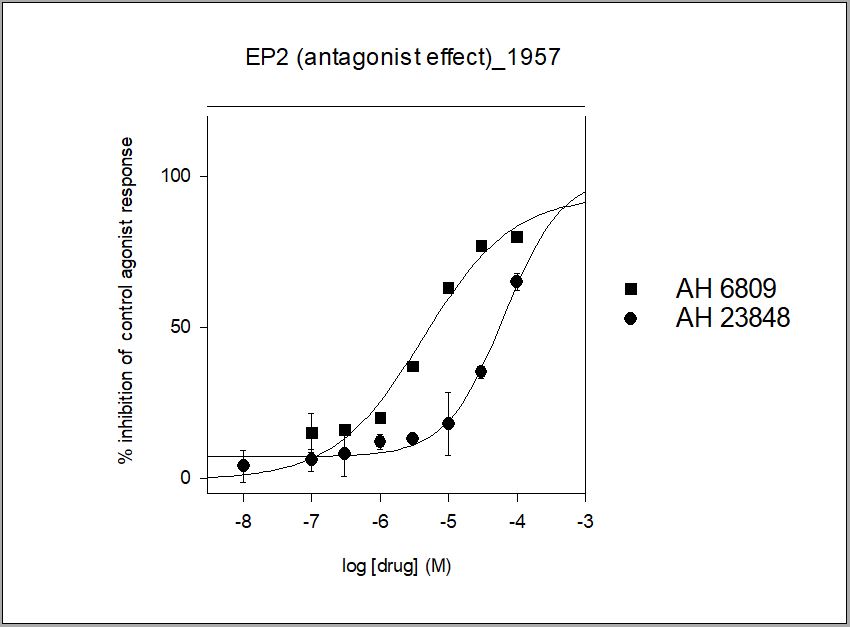
EP2 Human Prostanoid GPCR Cell Based Antagonist cAMP LeadHunter Assay - FR
OVERVIEW
DOCUMENTS/REFERENCES
Biological Information
Background Information:
Prostanoid receptors belong to the superfamily of G protein-coupled seven transmembrane proteins. G-protein-coupled receptors constitute one of the major signal transduction systems in eukaryotic cells. Coding sequences for these receptors, in those regions believed to contribute to the agonist-antagonist binding site, are strongly conserved across mammalian species. Prostanoid EP2 receptors are present in brain and many peripheral tissues (e.g., lung, placenta, uterus, ileum, stomach, spleen, thymus, etc.).
Family:
GPCR
Sub Family:
Prostanoid
Class:
Class A
Protein Name:
EP2
Uniprot Number:
P43116
Protein Aliases:
PGE2 receptor EP2 subtype|Prostanoid EP2 receptor
Gene Name:
PTGER2
Gene ID:
5732
Gene Aliases:
EP2
Accession Number:
NM_000956
Organism:
Human
Construct Details:
Recombinant
Cell Type:
CHO-K1
Assay Information
Assay Type:
Functional
Assay Sub Type:
Cell Based
Functional Mode:
Antagonist
Detection Method:
HTRF
Testing Information
Incubation:
30 min at 37°C
Control Inhibitor:
AH 6809
Control Activator:
PGE2 (50 nM)
Test Concentration / Dose:
Eurofins will provide IC/EC50 calculation if 5 or more concentrations are selected.
Test Sample Requirements:
Minimum for 1) Screen: 60 µL of 10 mM stock -OR- 1 mg (pre-weighed) for 10µM finµL testing. 2) Dose Response: 90 µL of 10 mM stock -OR- 1 mg (pre-weighed) for a top concentration at 10 µM.
Minimum Order Quantity:
16
Turnaround Time
Standard:
15 Business Days
Reference Compound Data
Clinical Relevance
Therapeutic Area:
Inflammation/Allergy
Adverse / Beneficial Action:
EP2 receptor agonism may reduce myometrial activity, bronchospasm and vasoconstriction as well as promote fever, increase gastrointestinal motility, renal nutriuresis and diuresis. EP2 receptor antagonism may be useful in the treatment of migraine but facilitate salt-sensitive hypertension.
Additional Information
Brand:
LeadHunter
Testing Location:
France - Celle L'Evescault
RELATED SOLUTIONS
EP2 Human Prostanoid GPCR Binding Agonist Radioligand LeadHunter Assay - FR
Item: 1955
EP2 Human Prostanoid GPCR Cell Based Agonist cAMP LeadHunter Assay - FR
Item: 1956
EP2 Human Prostanoid GPCR Cell Based Agonist & Antagonist cAMP LeadHunter Assay - FR
Item: G036
Questions? Contact Us
You can easily get in touch with a Eurofins Discovery Expert or get help from our Customer Service team. Reach out with questions, or to discuss your specific discovery challenges.
