Lck Human TK Kinase Enzymatic Radiometric LeadHunter Assay [10 μM ATP] - TW
OVERVIEW
DOCUMENTS/REFERENCES
Biological Information
Background Information:
The lck protooncogene is a member of the src-related gene family of non-receptor tyrosine kinases. It is uniquely expressed only in T-lymphocytes and NK-cells. The p56lck kinase (LCK) is a 56 KD polypeptide that is associated with a cytoplasmic face of the plasma membrane. It functions as a critical signalling model in IL-2 signal transduction leading to T-lymphocyte activation. Specifically, it has been shown that a stable complex exists between IL-2 receptors and p56lck and that treatment of T-lymphocytes with IL-2 promotes p56lck kinase activity and rapid phosphorylation of cellular substrates. In addition, p56lck has been found to function as a signal transducer for antigen activated CD4 and CG8 T-cell receptors and plays a role in thymic maturation of certain T-cells. The CD45 antigen, a receptor/protein tyrosine phosphatase of T-cells, also interacts with p56lck.
Family:
Kinase
Sub Family:
TK
Class:
Protein Tyrosine
Protein Name:
Lck
Uniprot Number:
P06239
Protein Aliases:
Leukocyte C-terminal Src kinase|LSK|Lymphocyte cell-specific protein-tyrosine kinase|Protein YT16|Proto-oncogene Lck|T cell-specific protein-tyrosine kinase|p56-LCK
Gene Name:
LCK
Gene ID:
3932
Accession Number:
NM_005356
Organism:
Human
Construct Details:
Full Length, Recombinant
Assay Information
Assay Type:
Biochemical
Assay Sub Type:
Enzymatic
Functional Mode:
Antagonist
Detection Method:
Radiometry
Measured Response:
Scintillation
Testing Information
Procedure Summary:
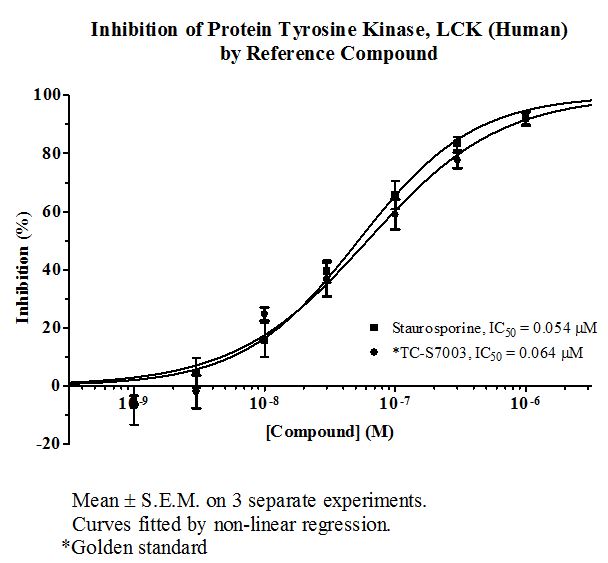
Human recombinant protein kinase LCK expressed in insect cells is used. Test compound and/or vehicle is preincubated with 0.4 μg/ml enzyme‡ in modified HEPES buffer pH 7.4 for 15 minutes at 37°C. The reaction is initiated by addition of 0.2 mg/ml poly(Glu:Tyr), 10 μM ATP and 0.25 μCi [γ32P]ATP for another 30 minute incubation period and terminated by further addition of 3% H3PO4. An aliquot is removed and counted to determine the amount of [32P]Poly(Glu:Tyr) formed. Compounds are screened at 10 μM.
Substrate:
200 µg/ml Poly(Glu:Tyr)
ATP Concentration:
10 uM
Incubation:
30 min at 37°C
Control Inhibitor:
TC-S 7003
Criteria For Significance:
≥ 50% of max stimulation or inhibition
Test Concentration / Dose:
Suggested concentration for initial testing is 10 uM
Test Sample Requirements:
Minimum for 1) Screen: 25 μl of 10 mM stock -OR- 1 mg (pre-weighed). 2) Dose Response: 60 μl of 10 mM stock -OR- 1 mg (pre-weighed).
Minimum Order Quantity:
2
Turnaround Time
Standard:
15 Business Days
Reference Compound Data
PubChem ID
Name
6-(2,6-Dimethylphenyl)-2-[[4-(4-methyl-1-pyrimido[5',4':5,6]
Measurement
0.064 μM - IC50
Clinical Relevance
Therapeutic Area:
Oncology/Immuno-Oncology
Adverse / Beneficial Action:
Inhibition of LCK may result in immune suppression and apoptosis.
Additional Information
Brand:
LeadHunter
Testing Location:
Taiwan - Taipei
RELATED SOLUTIONS
DrugMatrixScreen LeadHunter Panel - TW
Item: PP89
SafetyScreen87 Panel - TW
Item: PP223
SafetyScreen44 Panel - TW
Item: PP241
Questions? Contact Us
You can easily get in touch with a Eurofins Discovery Expert or get help from our Customer Service team. Reach out with questions, or to discuss your specific discovery challenges.
