PPARalpha Human NHR Functional Agonist & Antagonist Coactivator Assay, Panlabs
OVERVIEW
DOCUMENTS/REFERENCES
Biological Information
Background Information:
Peroxisomes proliferators include hypolipidemic drugs, leukotriene receptor antagonists and other materials. The term is used because they induce an increase in the size and number of peroxisomes, which are subcellular organelles found in animals and plants that contain enzymes for respiration and for cholesterol and lipid metabolism. The action of peroxisome proliferators is thought to be mediated via specific receptors, called PPARs, which belong to the steroid hormone receptor superfamily that function as transcription factors regulating the expression of genes. All PPARs heterodimerase with the retinoid X receptor (RXR) and bind to specific regions on the DNA of target genes. PPARs play essential roles in the regulation of cellular differentiation, development, and metabolism (carbohydrate, lipid, protein) of higher organisms. Three closely related subtypes (alpha, beta/delta, and gamma) have been identified. PPARA is expressed in liver, kidney, heart, muscle, adipose tissue, and others. PPARA is activated by leukotriene B4 as well as fibrate drugs used to lower cholesterol (generally adjunctive to statins) and disorders that feature high triglycerides.
No. of Assays on Panel:
2
Assays on Panel:
Family
NHR
Name
PPARalpha Human NHR Functional Agonist Coactivator Assay, Panlabs
Item
338210-0
Protein
PPARalpha
Organism
Human
Assay Sub Type
Protein-Protein Interaction
Family
NHR
Name
PPARalpha Human NHR Functional Antagonist Coactivator Assay, Panlabs
Item
338210-1
Protein
PPARalpha
Organism
Human
Assay Sub Type
Protein-Protein Interaction
Family:
NHR
Sub Family:
Peroxisome Proliferator-Activated
Class:
Non-Steroid
Protein Name:
PPARalpha
Uniprot Number:
Q07869
Gene Name:
PPARA
Gene ID:
5465
Gene Aliases:
hPPAR|NR1C1
Organism:
Human
Construct Details:
LBD, Recombinant
Assay Information
Assay Type:
Functional
Assay Sub Type:
Protein-Protein Interaction
Functional Mode:
Agonist & Antagonist
Detection Method:
TR-FRET
Measured Response:
Fluorescence
Testing Information
Procedure Summary:
Human recombinant peroxisome proliferators-activated receptor alpha (PPARA, PPARa, PPAR-alpha) hPPAR, NR1C1) receptors expressed in insect are used. Test compound and/or vehicle is incubated with the 2.5 nMǂ receptors and binding buffer in modified kit buffer pH 7.4 for 3 hours at RT. Determination of the amount of complex formed is read microplate reader (excitation:337 nm, emission:520/490 nm). Test compound-induced increase fluorescence by 50 percent or more (≥50%) relative to the 1 μM GW7647 response indicates possible PPARa receptor agonist activity. Test compound-induced inhibition of 20 nM GW7647-induced fluorescence response by 50 percent or more (≥50%) indicates receptor antagonist activity.
Incubation:
3 hr at RT
Control Inhibitor:
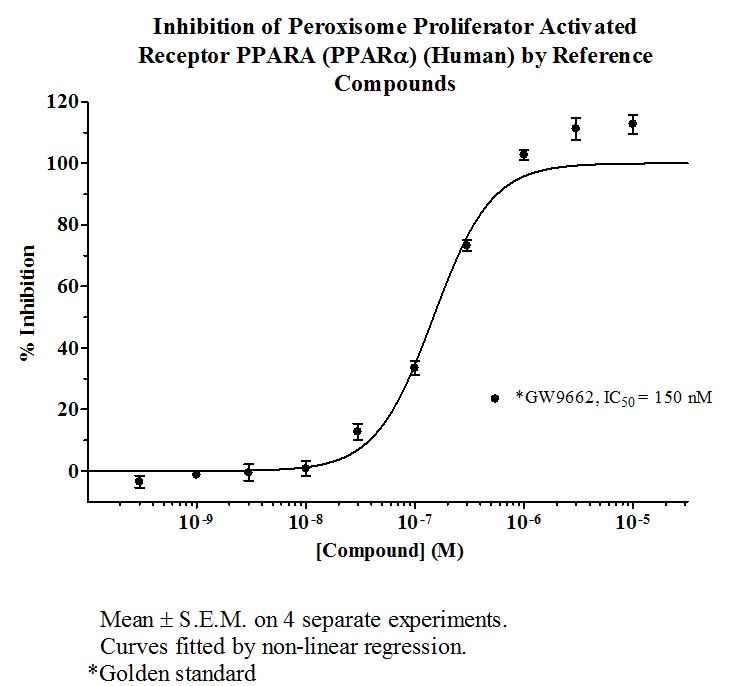
GW9662
Control Activator:
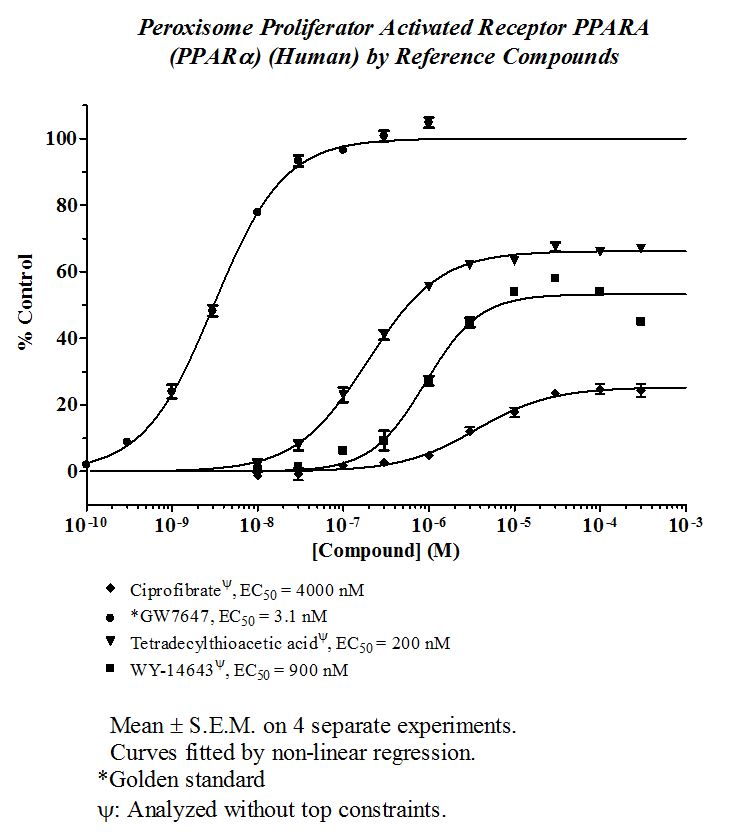
GW7647
Criteria For Significance:
≥ 50% increase in fluorescence relative to GW7647 response, ≥ 50% Inhibition of GW7647-induced fluorescence
Test Concentration / Dose:
Compounds are screened at 10, 3, 1, 0.3, 0.1, 0.03, 0.01 and 0.003 μM
Test Sample Requirements:
75 μl of 10 mM stock or 1 mg (pre-weighed) powder (assuming FW ≦500 and purity 100%)
Minimum Order Quantity:
16
Turnaround Time
Standard:
15 Business Days
Reference Compound Data
Clinical Relevance
Therapeutic Area:
Cardiovascular
Adverse / Beneficial Action:
PPARA receptor agonism may be used to lower cholesterol (generally adjunctive to statins) and treat disorders that feature high triglycerides
Additional Information
Brand:
Panlabs
Testing Location:
Taiwan - Taipei
Questions? Contact Us
You can easily get in touch with a Eurofins Discovery Expert or get help from our Customer Service team. Reach out with questions, or to discuss your specific discovery challenges.
