Cathepsin K Human Papain Cysteine Peptidase Enzymatic LeadHunter Assay - TW
OVERVIEW
DOCUMENTS/REFERENCES
Biological Information
Background Information:
Cathepsin B, H, K, L and S are lysosomal cysteine proteases and participate in a variety of proteolytic processes, including degradation of the extracellular matrix. Cathepsin K is highly and selectively expressed in osteoclasts, closely involved in osteoclastic bone resorption and may participate partially in the disorder of bone remodeling. Inhibitors of cathepsin K are in development for treatment of osteoporosis and other disease targets such as osteoarthritis and bone metastasis.
Family:
Protease
Sub Family:
Papain
Class:
Cysteine Peptidase
Protein Name:
Cathepsin K
Uniprot Number:
P43235
Gene Name:
CTSK
Gene ID:
1513
Gene Aliases:
PKND
Accession Number:
NM_000396
Organism:
Human
Construct Details:
Full Length, Recombinant
Assay Information
Assay Type:
Biochemical
Assay Sub Type:
Enzymatic
Functional Mode:
Antagonist
Detection Method:
Spectrofluorimetry
Measured Response:
Fluorescence
Testing Information
Procedure Summary:
Human recombinant cathepsin K expressed in insect cells is used. Test compound and/or vehicle is incubated with 0.02 µg/ml enzyme‡ in modified HEPES buffer pH 7.4 for 15 minutes at 25⁰C. The reaction is initiated by addition of 10 µM Z-Phe-Arg-AMC for another 30 minutes incubation period. Determination of the amount of AMC formed is read spectrofluorimetrically at 360/465 nm. Compounds are screened at 10 µM.
Substrate:
10 µM Z-Phe-Arg-AMC
Incubation:
30 min at 25°C
Control Inhibitor:
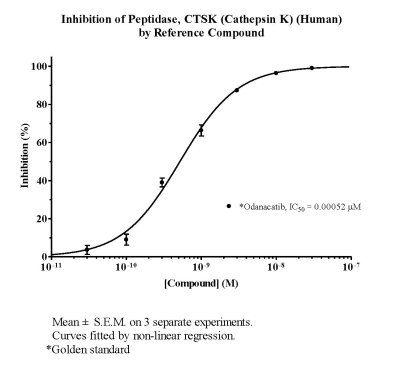
Odanacatib
Criteria For Significance:
≥ 50% of max stimulation or inhibition
Test Concentration / Dose:
Suggested concentration for initial testing is 10 uM
Test Sample Requirements:
Minimum for 1) Screen: 25 μl of 10 mM stock -OR- 1 mg (pre-weighed). 2) Dose Response: 60 μl of 10 mM stock -OR- 1 mg (pre-weighed).
Minimum Order Quantity:
2
Turnaround Time
Standard:
15 Business Days
Reference Compound Data
Clinical Relevance
Therapeutic Area:
Metabolic Diseases
Additional Information
Brand:
LeadHunter
Testing Location:
Taiwan - Taipei
RELATED SOLUTIONS
Cathepsin LeadHunter Panel - TW
Item: PP326
Questions? Contact Us
You can easily get in touch with a Eurofins Discovery Expert or get help from our Customer Service team. Reach out with questions, or to discuss your specific discovery challenges.
