D3 Human Dopamine GPCR GTPgammaS Antagonist LeadHunter Assay - TW
OVERVIEW
DOCUMENTS/REFERENCES
Biological Information
Background Information:
Five subtypes of dopamine receptors, D1, D2, D3, D4 and D5, were identified on the basis of pharmacological or biochemical criteria. Dopamine receptors have been classified into either the D1-like (D1, D1B, and D5) or D2-like (D2, D3, and D4). The selective D3 receptor involvement in regulating cognition and awareness states, and not generalized motor coordination, have potential therapeutic utility in treating attention deficit disorders.
Family:
GPCR
Sub Family:
Dopamine
Class:
Class A
Protein Name:
D3
Uniprot Number:
P35462
Gene Name:
DRD3
Gene ID:
1814
Accession Number:
NM_000796.3
Organism:
Human
Construct Details:
Full Length, Recombinant
Cell Type:
CHO-K1
Assay Information
Assay Type:
Functional
Assay Sub Type:
GTPgammaS
Functional Mode:
Antagonist
Detection Method:
Radiometry
Measured Response:
Scintillation
Testing Information
Incubation:
30 min at 30°C
Control Inhibitor:
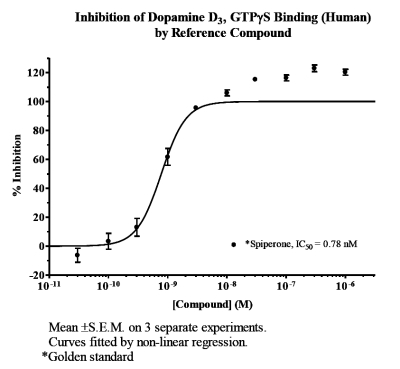
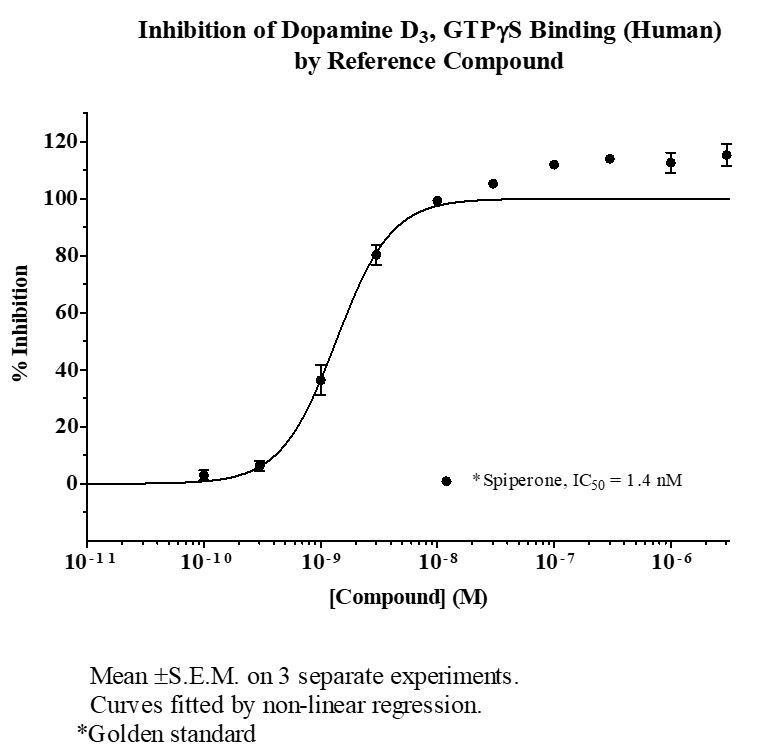
Spiperone
Criteria For Significance:
≥ 50% Increase in bound [35S]GTPgammaS relative to dopamine response, ≥ 50% Inhibition of dopamine-induced bound [35S]GTPgammaS
Test Concentration / Dose:
Compounds are screened at 10, 3, 1, 0.3, 0.1, 0.03, 0.01 and 0.003 μM
Test Sample Requirements:
75 μl of 10 mM stock or 1 mg (pre-weighed) powder (assuming FW ≦500 and purity 100%)
Minimum Order Quantity:
16
Turnaround Time
Standard:
20 Business Days
Reference Compound Data
Clinical Relevance
Therapeutic Area:
CNS/Addiction/Pain
Adverse / Beneficial Action:
Dopamine D3 receptor antagonist may be useful in treatment of psychosis, possibly without causing tardive dyskinesia, attention deficit disorder and hyperprolactemia; receptor antagonism has also been reported to attenuate cocaine addiction
Additional Information
Brand:
LeadHunter
Testing Location:
Taiwan - Taipei
RELATED SOLUTIONS
D3 Human Dopamine GPCR GTPgammaS Agonist & Antagonist LeadHunter Assay - TW
Item: 310400
D3 Human Dopamine GPCR GTPgammaS Agonist LeadHunter Assay - TW
Item: 310400-0
D3 Human Dopamine GPCR Binding Antagonist Radioligand LeadHunter Assay - TW
Item: 219800
Questions? Contact Us
You can easily get in touch with a Eurofins Discovery Expert or get help from our Customer Service team. Reach out with questions, or to discuss your specific discovery challenges.
