mu (MOP) Human Opioid GPCR Binding Agonist Radioligand LeadHunter Assay - FR
OVERVIEW
DOCUMENTS/REFERENCES
Biological Information
Background Information:
Opiates exert their effects in the central and peripheral nervous systems through interaction with m, k and d, three major types of opioid receptors, which are structural homologues and belong to the G protein-coupled receptor (GPCR) family. G-protein cascades activated by these three receptors can reduce adenylyl cyclase activity, alter inositol trisphosphate turnover, activate G-protein-linked, inward potassium channels, and close calcium channels. These receptors mediate the actions of opiate drugs and endogenous opioid neuropeptides in producing euphoria, modulating pain perception, and altering other important functions in the central and peripheral nervous systems.
Family:
GPCR
Sub Family:
Opioid
Class:
Class A
Protein Name:
mu (MOP)
Uniprot Number:
P35372
Protein Aliases:
MOR-1|Mu opiate receptor|Mu opioid receptor|MOP|hMOP
Gene Name:
OPRM1
Gene ID:
4988
Gene Aliases:
MOR1
Accession Number:
NM_000914
Organism:
Human
Construct Details:
Recombinant
Assay Information
Assay Type:
Biochemical
Assay Sub Type:
Binding
Detection Method:
Radiometric
Measured Response:
Scintillation
Testing Information
Ligand:
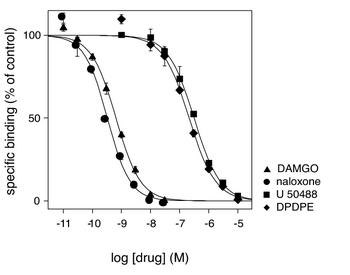
[3H]DAMGO
Ligand Kd (nM):
0.35
Ligand Concentration:
0.5 nM
Non Specific:
10 µM Naloxone
Incubation:
120 min at RT
Control Inhibitor:
DAMGO
Test Concentration / Dose:
Eurofins will provide IC/EC50 calculation if 5 or more concentrations are selected.
Test Sample Requirements:
Minimum for 1) Screen: 60 µl of 10 mM stock -OR- 1 mg (pre-weighed) for 10µM final testing. 2) Dose Response: 90 µl of 10 mM stock -OR- 1 mg (pre-weighed) for a top concentration at 10 µM.
Minimum Order Quantity:
2
Turnaround Time
Standard:
10 Business Days
Reference Compound Data
Clinical Relevance
Therapeutic Area:
CNS/Addiction/Pain
Adverse / Beneficial Action:
Opioid receptor agonists may be analgesic, reduce gastrointestinal transit, adversely affect respiration and become addictive.
Additional Information
Brand:
LeadHunter
Testing Location:
France - Celle L'Evescault
RELATED SOLUTIONS
mu (MOP) Human Opioid GPCR Cell Based Agonist cAMP LeadHunter Assay - FR
Item: 1392
ExpressProfile LeadHunter Panel - FR
Item: P1
BioPrint SafetyScreen Panel - FR
Item: P22-p
SafetyScreen44 Panel - FR
Item: P270
Drug Abuse Potential SafetyScreen Panel - FR
Item: P293
LeadProfilingScreen2 LeadHunter Panel - FR
Item: P3
SafetyScreen87 Panel - FR
Item: P342
CNS SafetyScreen panel - FR
Item: P411
SafetyScreen18 Core Panel - FR
Item: P447
SafetyScreen77 Core Extended Panel - FR
Item: P456
Questions? Contact Us
You can easily get in touch with a Eurofins Discovery Expert or get help from our Customer Service team. Reach out with questions, or to discuss your specific discovery challenges.
