NK3 Human Tachykinin GPCR Binding Antagonist Radioligand LeadHunter Assay - FR
OVERVIEW
DOCUMENTS/REFERENCES
Biological Information
Background Information:
Tachykinins belong to the superfamily of G protein-coupled seven transmembrane proteins. G-protein-coupled receptors constitute one of the major signal transduction systems in eukaryotic cells. Coding sequences for these receptors, in those regions believed to contribute to the agonist-antagonist binding site, are strongly conserved across mammalian species. Tachykinin receptors are found in most peripheral tissue and within the central nervous system.
Family:
GPCR
Sub Family:
Tachykinin
Class:
Class A
Protein Name:
NK3
Uniprot Number:
P29371
Protein Aliases:
neurokinin beta receptor
Gene Name:
TACR3
Gene ID:
6870
Gene Aliases:
NK3R|TAC3R
Accession Number:
NM_001059
Organism:
Human
Construct Details:
Recombinant
Assay Information
Assay Type:
Biochemical
Assay Sub Type:
Binding
Detection Method:
Radiometric
Measured Response:
Scintillation
Testing Information
Ligand:
[3H]SR 142801
Ligand Kd (nM):
0.47
Ligand Concentration:
0.4 nM
Non Specific:
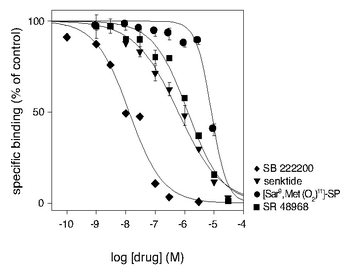
10 µM SB 222200
Incubation:
120 min at RT
Control Inhibitor:
SB 222200
Test Concentration / Dose:
Eurofins will provide IC/EC50 calculation if 5 or more concentrations are selected.
Test Sample Requirements:
Minimum for 1) Screen: 60 µl of 10 mM stock -OR- 1 mg (pre-weighed) for 10µM final testing. 2) Dose Response: 90 µl of 10 mM stock -OR- 1 mg (pre-weighed) for a top concentration at 10 µM.
Minimum Order Quantity:
2
Turnaround Time
Standard:
10 Business Days
Reference Compound Data
Clinical Relevance
Therapeutic Area:
CNS/Addiction/Pain
Adverse / Beneficial Action:
Tachykinin receptor agonism may result in vasodilation, salivary and mucous secretion, emesis, brochoconstriction, micturation, modulate behavior, increase pain transmission and neurogenic inflammation. Tachykinin receptor antagonism may find therapeutic use in the treatment of pain, emesis, inflammatory diseases and anxiety or depression.
Additional Information
Brand:
LeadHunter
Testing Location:
France - Celle L'Evescault
RELATED SOLUTIONS
NK3 Human Tachykinin GPCR Cell Based Agonist Calcium Flux LeadHunter Assay - FR
Item: 1312
NK3 Human Tachykinin GPCR Cell Based Antagonist Calcium Flux LeadHunter Assay - FR
Item: 1766
NK3 Human Tachykinin GPCR Cell Based Agonist & Antagonist Calcium Flux LeadHunter Assay - FR
Item: G087
ExpressProfile LeadHunter Panel - FR
Item: P1
LeadProfilingScreen2 LeadHunter Panel - FR
Item: P3
Diversity LeadHunter Panel - FR
Item: P9
SafetyScreen59 Extended Panel - FR
Item: P448
SafetyScreen33 Delta Panel - FR
Item: P453
SafetyScreen77 Core Extended Panel - FR
Item: P456
Questions? Contact Us
You can easily get in touch with a Eurofins Discovery Expert or get help from our Customer Service team. Reach out with questions, or to discuss your specific discovery challenges.
